 ★ PROGRAMMER'S GUIDE ★ CD communication I / F (CD part)
the term | meaning |
|---|---|
sector | A basic unit of data handled by a CD block. (Fixed at 2352 bytes) |
stream | A logically continuous flow of data that is distinguished by sector headers and subheaders. |
CD buffer | A buffer in a CD block that stores sector data. |
CD buffer size | The size of the CD buffer in sectors. |
Buffer partition | A CD buffer divided into multiple logical partitions. |
Buffer partition size | The size of the buffer partition in sectors. |
Sector position | The location of the sector within the buffer partition. (Sector unit position) |
Aperture | A logical element that separates streams according to set conditions. |
selector | A logical element that selects a stream, consisting of an aperture and a buffer compartment. |
device | A logical device that generates and absorbs streams such as CD-ROM and MPEG. Stream selection processing is possible by connecting a device to the above circuit. |
connector | Terminals for connecting apertures, buffer compartments, and devices. |
Frame address (FAD) | A numbered frame by frame, with the absolute time 00:00:00 on the CD as 0. |
Logical sector number (LSN) | A numbered sector (frame) unit is continuously numbered with the absolute time 00:02:00 on the CD as 0. Logical sector number = frame address -150 (for 2 seconds). |
File information | Directory record information held to access files. |
File identifier | A sequence number in the directory to identify the file. |
Symbols / abbreviations | meaning | explanation |
|---|---|---|
Adr | address | address |
BCD | binary coded decimal | Binary coded decimal |
bn, bufno | buffer no. | Buffer partition number |
bufnum | buffer numbers | Total number of buffer partitions |
CI | coding information | Coding information |
CN | channel no. | Channel number |
Ctrl | control | Control |
dst | destination | Copy / move destination |
fad | frame address | Frame address |
fasnum | fad sector numbers | Number of frame address sectors |
fid | file identifier | File identifier |
fln, filtno | filter no. | Aperture number |
FN | file no. | File number |
LSB | least significant bit | Lesi bit |
MSB | most significant bit | Most significant bit |
ply | play parameter | Playback parameters |
pos | position parameter | Positional parameters |
SM | submode | Submode |
sct | sector | sector |
ses | session information | Session information |
sesno | session no. | Session number |
snum | sector numbers | Number of sectors (when specifying the sector range of the partition) |
sp, spos | sector position | Sector position (when specifying the sector range of the partition) |
src | source | Copy / move destination |
stat | CD status information | CD status information |
subh | subheader condition | Subheader condition for aperture |
TNO | track no. | Track number (song number) |
toc | TOC information | TOC information |
txwnum | transfer word numbers | Number of transfer words (data transfer size per word) |
X, idx | index | Index number |
word | word | word. A unit of length of 2 bytes (16 bits). |
Figure 2.1 Relationship between track structure and access keys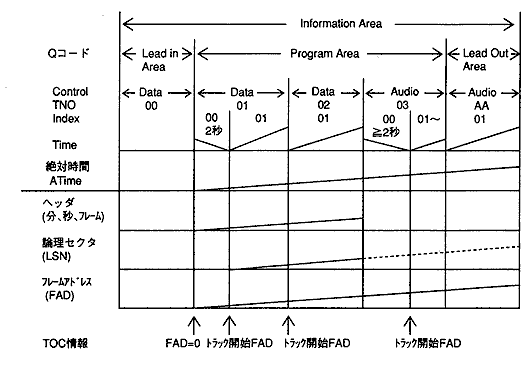
Figure 2.2 Multi-session layout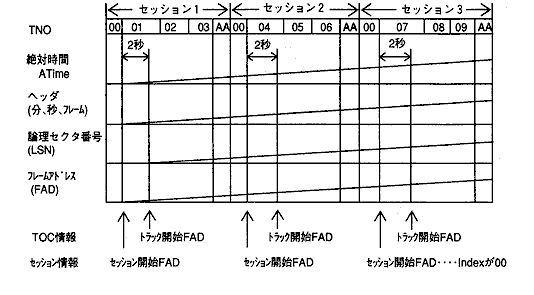
★ PROGRAMMER'S GUIDE ★ CD communication I / F (CD part)