 ★ SGL User's Manual ★ PROGRAMMER'S STRUCT
 <Fig. 8-30 Character numerical display image>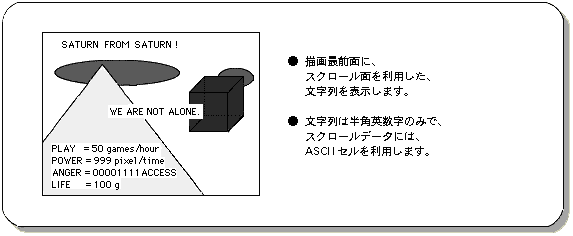
Character-numerical display functions can be broadly classified into the following four types.

Display Position Calculation: Create display position parameters for use in the function.
Display character string: Displays the specified character string on the screen.
Numerical value display: Displays the specified numerical value on the screen.
Matrix display: Displays the specified matrix on the screen.
| Substituted value | Output value | |
|---|---|---|
| slPrintHex | 00001111 | 1111 |
| slDispHex | 00001111 | 00001111 |
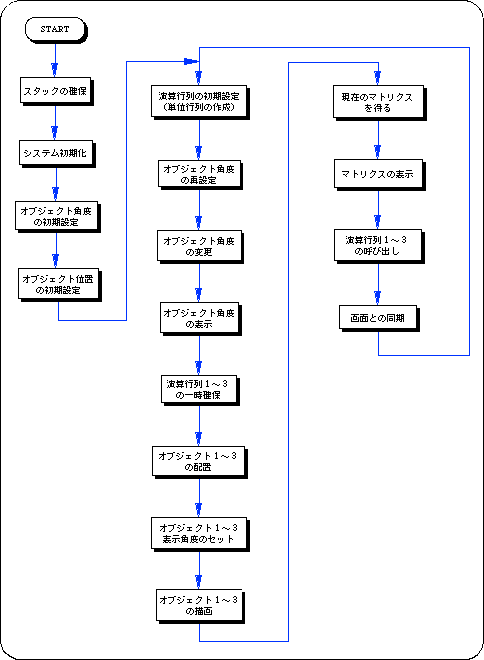
The following sample program (Listing 8-10) actually uses a group of character / numerical display functions to realize screen display of character strings and numerical values using a scroll screen.
Listing 8-10 sample_8_12: Character / numerical display
/ * ------------------------------------------------ ---------------------- * /
/ * Text & Value Display * /
/ * ------------------------------------------------ ---------------------- * /
#include "sgl.h"

extern PDATA PD_PLANE1, PD_PLANE2, PD_PLANE3;

static void set_poly (ANGLE ang [XYZ], FIXED pos [XYZ])
{
	slTranslate (pos [X], pos [Y], pos [Z]);
	slRotX (ang [X]);
	slRotY (ang [Y]);
	slRotZ (ang [Z]);
}

void ss_main (void)
{
	static ANGLE ang1 [XYZ], ang2 [XYZ], ang3 [XYZ];
	static FIXED pos1 [XYZ], pos2 [XYZ], pos3 [XYZ];
	static MATRIX mtptr;
	static ANGLE adang = DEGtoANG (0.5);
	static ANGLE tmp = DEGtoANG (0.0);

	slInitSystem (TV_320x224, NULL, 1);

	slPrint ("Sample program 8.12", slLocate (6,2));

	ang1 [X] = ang1 [Y] = ang1 [Z] = DEGtoANG (0.0);
	ang2 [X] = ang2 [Y] = ang2 [Z] = DEGtoANG (0.0);
	ang3 [X] = ang3 [Y] = ang3 [Z] = DEGtoANG (0.0);
	pos1 [X] = toFIXED (0.0);
	pos1 [Y] = toFIXED (40.0);
	pos1 [Z] = toFIXED (170.0);
	pos2 [X] = toFIXED (0.0);
	pos2 [Y] = toFIXED (-40.0);
	pos2 [Z] = toFIXED (0.0);
	pos3 [X] = toFIXED (0.0);
	pos3 [Y] = toFIXED (-40.0);
	pos3 [Z] = toFIXED (0.0);

	slPrint ("POLYGON ANGLE [Hex] =", slLocate (1,4));
	slPrint ("POLYGON ANGLE [Dec] =", slLocate (1,6));
	slPrint ("POLYGON ANGLE [Hex & 0] =", slLocate (1,8));
	slPrint ("POLYGON ANGLE [Dec & 0] =", slLocate (1,10));
	slPrint ("POLYGON ANGLE [FIX] =", slLocate (1,12));
	slPrint ("DISPLAY Matrix:", slLocate (1,18));

	while (-1) {
		slUnitMatrix (CURRENT);
		ang1 [Z] = tmp;
		ang2 [Z] = tmp;
		tmp + = adang;
		if (tmp <DEGtoANG (-90.0)) {
			adang = DEGtoANG (0.5);
		} else if (tmp> DEGtoANG (90.0)) {
			adang = DEGtoANG (-0.5);
		}

		slDispHex (slAng2Hex (tmp), slLocate (26,4));
		slDispHex (slAng2Dec (tmp), slLocate (26,6));
		slPrintHex (slAng2Hex (tmp), slLocate (26,8));
		slPrintHex (slAng2Dec (tmp), slLocate (26,10));
		slPrintFX (slAng2FX (tmp), slLocate (26,12));

		slPushMatrix ();
		{
			set_poly (ang1, pos1);
			slPutPolygon (& PD_PLANE1);

			slPushMatrix ();
			{
				set_poly (ang2, pos2);
				slPutPolygon (& PD_PLANE2);

				slPushMatrix ();
				{
					set_poly (ang3, pos3);
					ang3 [Y] + = DEGtoANG (5.0);
					slPutPolygon (& PD_PLANE3);
					slGetMatrix (mtptr);
					slPrintMatrix (mtptr, slLocate (0,20));
				}
				slPopMatrix ();
			}
			slPopMatrix ();
		}
		slPopMatrix ();

		slSynch ();
	}
}
 ★ SGL User's Manual ★ PROGRAMMER'S STRUCT