■ EG register
- EG represents the change in sound attenuation over time. The EG has the following four states.
- Attack state (attack segment)
- The state of the beginning (rising) of sound
- Decay 1 state (decay 1 segment)
- A state in which the volume is attenuated from the maximum volume.
- Decay 2 state (decay 2 segment)
- It is a state in which the decay is further attenuated from the Decay 1 state. However, if DR2 is set to "0", it will not be attenuated and will be in a continuous sound state.
- Release status (release segment)
- The state in which the sound is attenuated and disappears from the time when KEY_OFF is turned off.
- However, in all the sounding states, the EG does not transition between the four states, and draws various envelope curves depending on the timing of KEY_OFF. An example is explained below.
- (a) When KEY_OFF is performed during the attack state transition (Fig. 4.6)
Figure 4.6 KEY_OFF during attack state transition
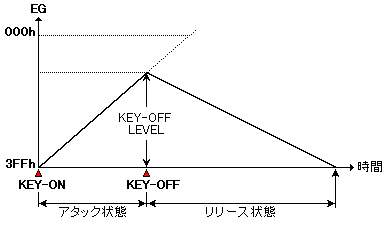
- When KEY-OFF is performed, the level (KEY_OFF LEVEL) at that time is attenuated (increased as the EG value) according to the release rate ("RR") setting value. Therefore, the envelope curve in this case looks like the Decay 1 state and Decay 2 state are omitted. In this case, the EG value does not reach "000H" and increases to "3FFH" at KEY_OFF.
- (b) When KEY_OFF is performed during the decay 1 segment transition (Fig. 4.7)
Figure 4.7 KEY-OFF during decay state transition
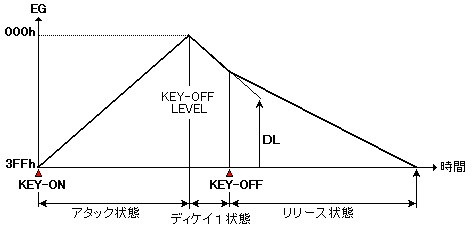
- When entering the Decay 1 state, it will be attenuated toward DL (Decay level) according to the D1R (Decay 1 rate) setting value. If KEY_OFF is executed during this process, the level (KEY_OFF-LEVEL) at the time of KEY_OFF is attenuated according to the RR (release rate) setting value.
- AR [4: 0] (R / W); Attack Rate
- Specifies the amount of change in EG in the attack state.
- Contents of AR register
- When "AR" = "00H", the amount of change (level increase) is the minimum (0)
- When "AR" = "1FH", the amount of change (level increase) is maximum (MAX)
- EGHOLD (R / W) EG HOLD mode
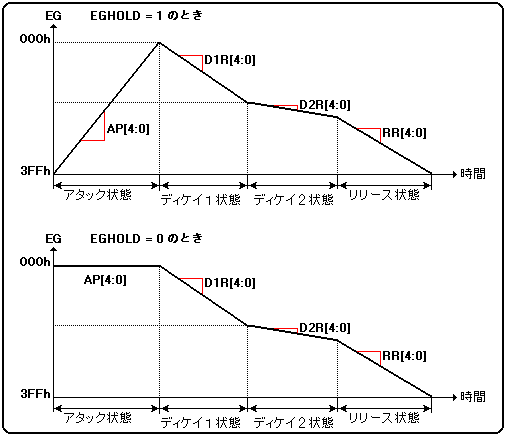
- Specifies whether to keep or change the value in the attack. As shown in Figure 4.6 , when this bit is "1B", the value at attack is held at "000H". When the bit is "0B", it changes according to the value specified in the AR register. When in hold mode, the time that the EG holds "000H" (the time until it moves to segment 2) is determined by the value of "AR".
Figure 4.8 Change in attenuation
- D1R [4: 0] (R / W); Decay-1 Rate
- Specifies the amount of change in EG in Decay 1 state.
- Contents of D1R register
- When "D1R" = "00H", the amount of change (level attenuation) is the minimum (0)
- When "D1R" = "1FH", the amount of change (level attenuation) is maximum (MAX)
- D2R [4: 0] (R / W); Decay-2 Rate
- Specifies the amount of change in EG in the Decay 2 state.
- Contents of D2R register
- When "D2R" = "00H", the amount of change (level attenuation) is the minimum (0)
- When "D2R" = "1FH", the amount of change (level attenuation) is maximum (MAX)
- RR [4: 0] (R / W); Release Rate
- Specifies the amount of change in EG in the release state.
- Contents of RR register
- When "RR" = "00H", the amount of change (level attenuation) is the minimum (0)
- When "RR" = "1FH", the amount of change (level attenuation) is maximum (MAX)
- DL [4: 0] (R / W); Decay Level
- Specifies the upper 5 bits of the attenuation level (EG) that transitions from the Decay 1 state to the Decay 2 state. When the upper 5 bits of the attenuation level become equal to the DL value in the Decay 1 state, the state transitions to Decay 2.
- Contents of DL register
- When "DL" = "00H", the maximum level (MAX)
- When "DL" = "1FH", the minimum level (MIN)
- KRS [3: 0] (R / W) Key Rate Scaling
- Specifies the degree of key rate scaling for the EG.
- Contents of KRS register
- Minimum scaling at 00H
- 0EH represents the maximum scaling.
- When 0FH, specify scaling OFF.
- LPSLNK (R / W); LooP Start LiNK
- The function of "LPSLNK" (loop start link) synchronizes the start of the loop with the transition from the attack state of the EG to the decay 1 state.
- Contents of LPSLNK register
- "LPSLNK" = "0B": The state transition of EG and the position of the loop start point are irrelevant.
- "LPSLNK" = "1B": The following changes can be seen.
- When the EG reaches "000H" in the attack state, the waveform read address does not reach the loop start point ("SA" + "LSA").
- If it was early in time
- If it was late in time
- When the EG reaches "000H" in the attack state, the waveform read address is earlier than the loop start point ("SA" + "LSA") (Fig. 4.9).
- In this case, the EG reaches the MAX level first (P.1). However, the EG continues to hold the MAX level because it cannot transition to the next segment (decay 1 state) until the waveform read address reaches the loop start point.
Next, when the waveform read address reaches the loop start point (P.2), the EG will transition to the Decay 1 state. Figure 4.9 Transition from attack state to decay 1 (1)
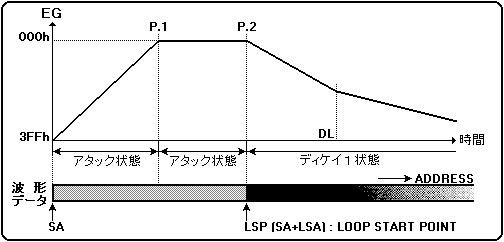
Figure 4.9 Transition from attack state to decay 1 (1)
- When the EG reaches "000H" in the attack state, the waveform read address is later than the loop start point ("SA" + "LSA").
- There are two more patterns in this pattern.
- Pattern 1
- When the waveform read address reaches the loop start point and the "SCL" (EG level) at this point is larger than the "DL" (decay level) (reverse when compared with the actual EG value) (Fig. 4.10)
Figure 4.10 Transition from attack state to decay 1 (2)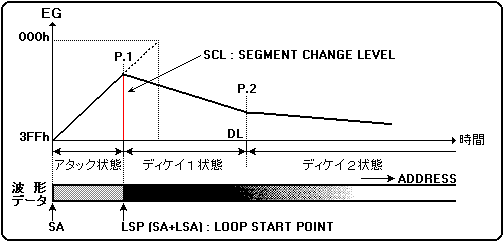
Figure 4.10 Transition from attack state to decay 1 (2)
- After the waveform read address reaches the loop start point, the EG transitions to the Decay 1 state (P.1). Next, when the EG value reaches DL (decay level), it transitions to the decay 2 state (P.2).
- Pattern 2
- When the waveform read address reaches the loop start point and the "SCL" (EG level) at this point is smaller than the "DL" (decay level) (reverse when compared with the actual EG value) (Fig. 4.11)
Figure 4.11 Transition from attack state to decay 1 (3)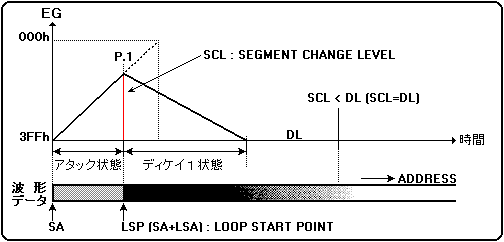
- After the waveform read address reaches the loop start point, the EG transitions to the Decay 1 state (P.1). After that, the value of EG never reaches "DL" (decay level), so it keeps level 0 ("3FFH" as the value of EG) without transitioning to the decay 2 state.
