PROGRAMMER'S GUIDEDISC format standard specifications
BackForward
DISC format standard specifications

DISC logical format


■ Overview

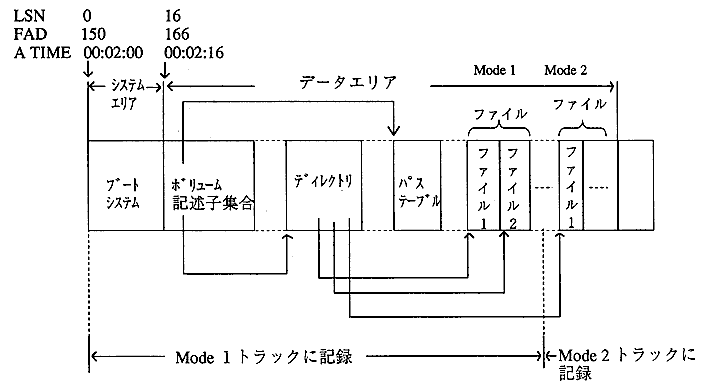
The CD-ROM area and CD-ROM XA area consist of a system area and a data area.
At the beginning of the data area, the volume descriptor set, directory, and path table for describing the volume / file structure of the disk are recorded. (Fig. 3.1)
Be sure to record the system area, volume descriptor set, root directory, and path table on the Mode1 track.

Figure 3.1 Overview of the CD-ROM area and CD-ROM XA area

■ Volume / file structure

● Overview
The volume / file structure conforms to ISO9660.
Information has been added to the system area of the directory record.

● Abbreviation for data type
Use the following abbreviations to describe the volume / file structure.

Table 3.1 Abbreviations for data types
 Abbreviation
 Model name
 explanation
 N
 Numeric Value
 8-bit binary number
 NL
 Least Significant Byte First
 LSBF notation 16/32 bit binary Numerical value Example) Hexadecimal number 1234 → 34 12 is recorded.
 NM
 MostSignificant Byte First
 MSBF notation 16/32 bit binary Numerical value Example) Hexadecimal number 1234 → 12 34 is recorded.
 NB
 Both-type orders
 LSBF notation + MSBF notation example) Hexadecimal number 1234 → 34 12 12 34 is recorded
 ND
 Any digit from ZERO-NINE
 Number in decimal notation
 A
 A-characters
 ASCII character string (20-22 / 25-3F / 41-5A / 5F)
 D
 D-characters
 Directory character string (30-3F / 41-5A / 5F)
 DS
 D-characters, SEPARATOR1,
SEPARATOR2
 D-characters +'.;' (2E / 3B)
 DE
 Directory Entry
 Directory entry format
 A1
 A1-characters
 A-characters + Kanji
 D1
 D1-characters
 D-characters + Kanji
 D1S
 D1-characters, SEPARATOR1,
SEPARATOR2
 D1-characters +'.;' (2E / 3B)
 00
 Zero fill
 Fill unused, reserved area, etc. with (00)

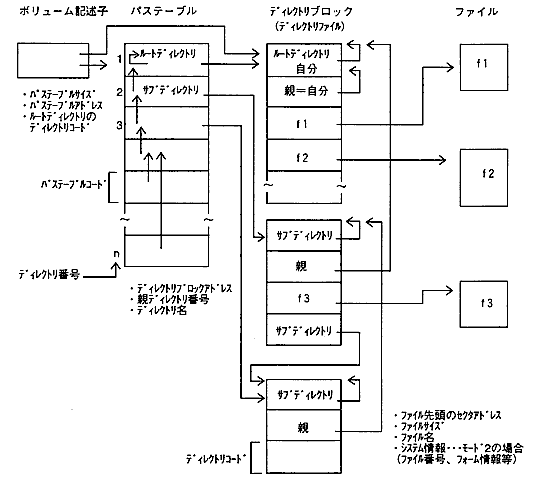
Figure 3.2 File management data structure on CD-ROM (ISO9660)

■ Volume Descriptor Set

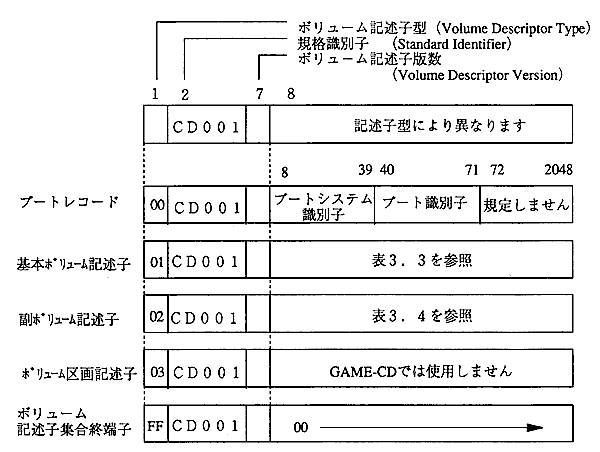
A volume descriptor set is a collection of volume descriptors recorded in consecutive sectors from logical sector number 16 (FAD = 166).
There are five types of volume descriptors: Of these, the volume partition descriptor is not used.

Figure 3.3 Volume descriptor

● Boot record

Table 3.2 Boot Record Structure
 Byte position
 Mold
 Field name
 explanation
 1
2-6
7
8 ~ 39
40-71
71-2048
 N

N
A
A

 Volume Descriptor Type
Standard Identifier
Volume Descriptor Version
Boot System Identifier
Boot Identifier
Boot System Use
 Volume descriptor type standard identifier'CD001'
Volume descriptor Version number Boot system identifier Boot identifier Not specified

In a normal GAME-CD, one sector each of the basic volume descriptor and the volume descriptor set terminator is recorded.
These two sectors must be recorded.

Make sure you understand how to use the secondary volume descriptor and boot record before using it.

● Primary Volume Descriptor
The volume descriptor set contains one base volume descriptor. The basic volume descriptor describes the volume attributes, the location of the root directory, the location of the path table group, and so on.
The details of the basic volume descriptor are shown in Table 3.3.

Table 3.3 Basic Volume Descriptor Structure
 Byte position
 Mold
 Field name
 explanation
 1
2-6
7
8
9-40
41-72
73-80
81-88
89-120
121-124
125-128
129 ~ 132
133-140
141-144

145 ~ 148

149-152

153 ~ 156

157-190
191 ~ 318
319 ~ 446
447 ~ 574
575 ~ 702
703 ~ 739
740-776
777-813
814 ~ 830
831-847
848 ~ 864
865 ~ 881
882
883
884 ~ 1395
1396-2048
 N

N
00
A
D
00
NB
00
NB
NB
NB
NB
NL

NL

NM

NM

DE
D
A
A
A
DS
DS
DS
ND
ND
ND
ND
N
00

 Volume Descriptor Type
Standard Identifier
Volume Descriptor Version
Unused Field
System Identifier
Volume Identifier
Unused Field
Volume Space Size
Unused Field
Volume Set Size
Volume Sequence Number
Logical Block Size
Path Table Size
Location of Occurence of
Type L Path Table
Location of Optional
Occurence of Type L Path Table
Location of Occurence of
Type M Path Table
Location of Optional Occurence of
Type M Path Table
Directory Record for Root Directory
Volume Set Identifier
Publisher Identifier
Data Preparer Identifier
Application Identifier
Copyright File Identifier
Abstract File Identifier
Bibliographic File Identifier
Volume Creation Date and Time
Volume Modification Date and Time
Volume Expiration Date and Time
Volume Effective Date and Time
File Structure Version
Reserved for future standardization
Application Use
Reserved for future standardization
 Volume descriptor type = 01
Standard identifier'CD001'
Volume descriptor version unused
System volume name that uses LSN 0 to 15 Number of sectors in the entire unused volume Number of volumes in unused multi-volume = 1
Volume serial number at the time of multi-volume Logical block length Number of bytes in the entire path table
Path table position in LSBF notation

Reserve

Path table position in MSBF notation

Reserve

Directory record of root directory Overall name during multi-volume Publisher identifier Data editor identifier Identification of data usage Copyright File name Abstract (summary) File name Bibliographic file name Creation date, time update date, time expiration date, time effective Date, time File structure Version number Reserved for future standardization
Compliant with CD-ROM XA standard Reserved for future standardization

The following areas are defined as disc labels in the CD-ROM XA standard.

Table 3.4 Disc Labels on CD-ROM XA
 Byte position
 Mold
 Field name
 explanation
 1025-1032
1033-1034
1035-1042
1043-1050


D
00
 Identifying Signature
CD-ROM XA Flags
Startup Directory
Reserved
 'CD-XA001'
Reserved area startup directory name Reserved area

● Supplementary Volume Descriptor
The volume descriptor set contains any number of subvolume descriptors. The secondary volume descriptor describes the volume attributes, the location of the root directory, the location of the path table group, and so on.
When using Japanese for identifiers such as volume names and publisher identifiers, record them in the secondary volume descriptor. The details of the secondary volume descriptor are shown in Table 3.5.

Table 3.5 Structure of secondary volume descriptor
 Byte position
 Mold
 Field name
 explanation
 1
2-6
7
8
9-40
41-72
73-80
81-88
89-120
121-124
125-128
129 ~ 132
133-140
141-144

145 ~ 148

149-152

153 ~ 156

157-190
191 ~ 318
319 ~ 446
447 ~ 574
575 ~ 702
703 ~ 739
740-776
777-813
814 ~ 830
831-847
848 ~ 864
865 ~ 881
882
883
884 ~ 1395
1396-2048
 N

N

A1
D1
00
NB
00
NB
NB
NB
NB
NL

NL

NM

NM

DE
D1
A1
A1
A1
D1S
D1S
D1S
ND
ND
ND
ND
N
00

 Volume Descriptor Type
Standard Identifier
Volume Descriptor Version
Volume Flag
System Identifier
Volume Identifier
Unused Field
Volume Space Size
Unused Field
Volume Set Size
Volume Sequence Number
Logical Block Size
Path Table Size
Location of Occurence of
Type L Path Table
Location of Optional
Occurence of Type L Path Table
Location of Occurence of
Type M Path Table
Location of Optional Occurence of
Type M Path Table
Directory Record for Root Directory
Volume Set Identifier
Publisher Identifier
Data Preparer Identifier
Application Identifier
Copyright File Identifier
Abstract File Identifier
Bibliographic File Identifier
Volume Creation Date and Time
Volume Modification Date and Time
Volume Expiration Date and Time
Volume Effective Date and Time
File Structure Version
Reserved for future standardization
Application Use
Reserved for future standardization
 Volume descriptor type standard identifier'CD001'
Volume descriptor version Volume flag
System volume name that uses LSN 0 to 15 Number of sectors in the entire unused volume Number of volumes in unused multi-volume = 1
Volume serial number at the time of multi-volume Logical block length Number of bytes in the entire path table
Path table position in LSBF notation

Reserve

Path table position in MSBF notation

Reserve

Directory record of root directory Overall name during multi-volume Publisher identifier Data editor identifier Identification of data usage Copyright File name Abstract (summary) File name Bibliographic file name Creation date, time update date, time expiration date, time effective Date, time File structure Version number Reserved for future standardization Not specified Reserved for future standardization

■ Directory

A directory is recorded as a single file consisting of multiple directory records. Individual directory records are uniquely identified within the same directory by file identification.
The file identification represents a file name or directory name and is stored in the following format.

Within 8 characters 
| Up to 3 characters, can be omitted 
| | Numbers 1-32767 (always set to 1)
↓ ↓ ↓ 
File identification → File name. Extension; version 
↑ ↑ ↑ 
| | Separator 2 "Semicolon" 
| Number of delimiters 1 "Period" 
| 
Directory name: 8 characters or less 
(The root directory is 1 byte 00H) 

Table 3.6 Directory Records
 Byte position
 Mold
 Field name
 explanation
 1
2
3-10
11-18
19-25
26
27
28
29-32
33
34 ~
(33 + LEN_FI)

34 + LEN_FI
 N
N
NB
NB
N

N
N
NB
N
D1S


00
 Length of Directory Record
Extended Attribute Record Length
Location of Extent
Data Length
Recording Date and Time
File Flags
File Unit Size
Interleave Gap Size
Volume Sequence Number
Length of File Identifier
File Identifier


Padding Field
System Use
 Directory record length Extended attribute record length extent position (LSN)
Data length Recording date / time File flag File unit size Interleaved gap size Volume sequence number File identification length File identification / file name. Extension: Version / directory name Information for embedded system

● Recording date / time format

Table 3.7 Recording date / time format
 Byte position
 Mold
 Field name
 explanation
 1
2
3
Four
Five
6
7

 N
N
N
N
N
N
N

 Number of years since 1900
Month of the year from 1 to 12
Day of the month from 1 to 31
Hour of the day from 0 to 23
Minute of the hour from 0 to 59
Second of the minute from 0 to 59
Offset from Greenwich Mean Time
in number of 15 min intervals
from-48 (West) to +52 (East)
 Years from 1900 Month Date Minutes Seconds Difference from Greenwich Mean Time
From -48 (west) to +52 (east) in 15-minute increments

● File flag

Table 3.8 File flags
 Bit position
 Field name
 explanation
 0
1
2
3
Four
Five
6
7
 Existence
Directory
Associated File
Record
Protection
Reserved
Reserved
Multi-Extent
 Invisible file directory File related file (= 0)
Extended attribute record structure file protection file (= 0)


Multiple extent files (= 0)

● File identification
The file name or directory name is stored according to the value of the directory bit (bit 1) of the file flag.
Directory bit = 0: Specify the identification information for the file.

Table 3.9 File identification
 Directory bit value
 format
 explanation
 0
 file name. Extension; Version number << Example >> aaaaaaaa.bbb; 1
xxxxxxxx; 1
 File name: 8 characters or less Extension: 3 characters or less (optional)
Edition number: Always 1
 1
 Directory name
 Directory name: 8 characters or less Root directory is 1 byte 00H

If the file identification length is even, 1 byte (00H) is embedded and inserted.

● System information
The following extensions have been made to the ISO9660 standard.

Table 3.10 System Information
 Byte position
 Mold
 Field name
 explanation
 14
5-6
7
8
9
10-14
 NM


N
00

Owner ID
Attributes
Signature byte 1
Signature byte 2
File Number
Reserved
 Owner group ID, owner ID
Attribute bit
'X' ($ 58)
'A' ($ 41)
File number reserved area

● Attribute bit

Table 3.11 Attribute bits
 Bit position
 Field name
 explanation
 0
1
2
3
Four
Five
6
7
8
9
Ten
11
12
13
14
15
 Owner Read
Reserved
Owner execute
Reserved
Group read
Reserved
Group execute
Reserved
World read
Reserved
World execute
File contains Form 1 sectors
File contains Form 2 sectors
File contains interleaved sector
CD-DA file
Directory


Contains Form 1 sector
Includes Form 2 sector Includes interleaved sector
CD-DA file directory file

■ Pass table

A pathtable record is recorded for each directory in the directory hierarchy. Pathtable records are numbered starting with 1 and the first record indicates the root directory.
The details of the path table record are shown below.

Table 3.12 Path table records
 Byte position
 Mold
 Field name
 explanation
 1
2
3-6
7-8
9 ~
(8 + LEN_DI)
9 + LEN_DI
 N
N
N
N
D1

00
 Length of Directory Identifier
Extended Attribute Record Length
Location of Extent
Parent Directory Number
Directory Identifier

Padding Field
 Directory name length Extended attribute record length Extension leading LSN
Parent directory entry number Directory name

Only if the directory name is odd

■ User file

User files are placed in the data area.
One file is not always arranged continuously, but generally it is arranged interleaved. Form1 and Form2 are mixed in the Mode2 sector, but the file size of each sector is converted to 2048 bytes.
For convenience, the Mode1 sector is formally treated as a Form1 sector with a subheader of 0.
The data in the Form2 sector must be in units of 2324 bytes, and fractional bytes are not allowed.

■ Other

● Directory structure
GAME-CD also supports subdirectory structures.

● Multi-volume
Does not support.

● Multi-session
Does not support.


BackForward
PROGRAMMER'S GUIDEDISC format standard specifications
Copyright SEGA ENTERPRISES, LTD., 1997