2-4. Creating a DSP program
- In Saturn, in addition to the songs played by the built-in sound source, it is possible to apply effects using the built-in DSP to the sounds from SE and CD. This section describes how to create a DSP program for that purpose.
However, sound can be produced without this DSP program, so if you want to produce sound with non-effects, you can skip this item. - 1) Start DSP Linker
- First, double-click the DSP Linker to start it. To create a new file, select “New” from the File menu and give it a name. This will open the Algorithm Edit window and will automatically add the “.YLI” extension to the file name.
- 2) Arrangement of DSP input / output modules
- Select “I / O Modules” from the Window menu to open the “I / O Modules” window.
Figure 2-20 I / O Module window
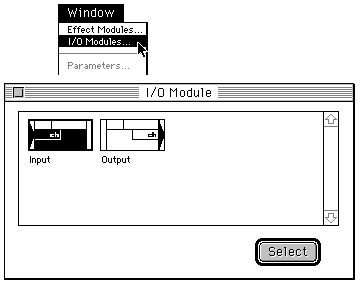
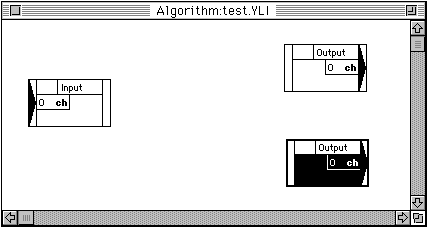
- By double-clicking the "Input" and "Output" (output from DSP) modules in the "I / O Module" window, or by clicking to select and selecting with the "Select" button. , Bring each module into the algorithm edit window. Here, we will build a reverb as an example, so let's import one "Input" module and two "Output" modules.
Move the imported modules to a position where they are easy to see so that they do not overlap. Figure 2-21 DSP I / O module layout
- 3) Arrangement of effect modules
- Select "Effect Modules" from the Window menu to open the "Effect Modules" window.
Figure 2-22 Effect Module window
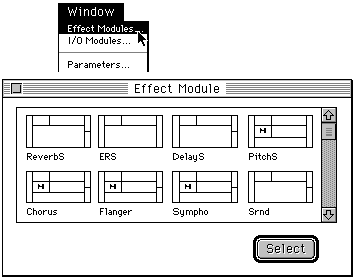
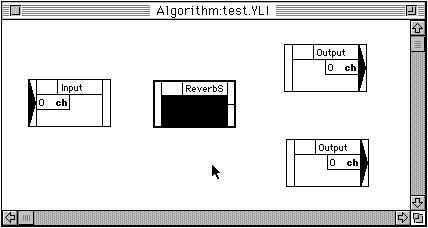
- Select the effect you want to apply from this and import it into the algorithm edit window in the same way as for the input / output module.
Figure 2-23 Arrangement of effect modules
- 4) Wiring between modules
- In order to determine the flow of sound data between each module, work is done to connect each module. Click the output port of a module and then the input port of the next module to connect each module with a line.
Figure 2-24 Wiring between modules
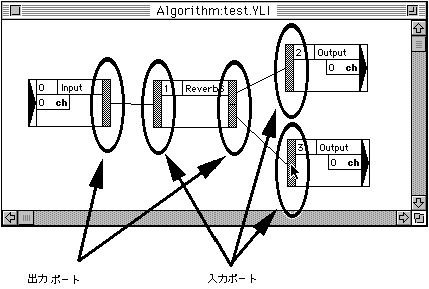
- In this way, sound data flows from the input module through the effect module (s) to the output module.
- 5) Link
- After connecting the modules, select “Link” from the Process menu to link the created effect algorithm. If the link is successful, the "Link Result Information" dialog is displayed. This dialog displays information about the usage of DSP-related hardware resources.
Figure 2-25 "Link Result Information" Dialog
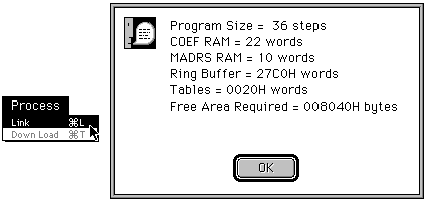
- The value indicated by "Free Area Required" in this "Link Result Information" dialog is the size of the DSP work RAM secured in the map.
When setting the DSP work RAM in the sound simulator, the start address is separated by 2000h. Even if you try to set a finer address than that, it will be automatically shifted back to a well-separated address. - Processing when “Ring buffer too small” message occurs
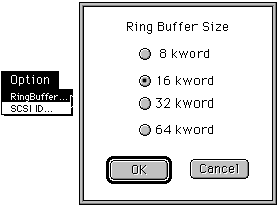
- Even if you try to link, the message “Ring buffer too small” may appear and you may not be able to link. In this case, select “Ring Buffer” from the Option menu to increase the size of the ring buffer. (The larger the ring buffer, the larger the size of the DSP work RAM that must be allocated in the map.)
Figure 2-26 Ring buffer size selection
- 6) Download
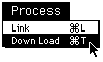
- After linking, select "Download" from the Process menu. The effect algorithm created by this will be downloaded to the target (development board), and the DSP will operate.
Figure 2-27 Download to target
- 7) Editing effect parameters
- The Parameter Edit window is opened by double-clicking the margin (the part where characters are not displayed) of each module in the algorithm edit window, or by selecting and then selecting "Parameters" from the Window menu. increase.
Figure 2-28 Editing the reverb module
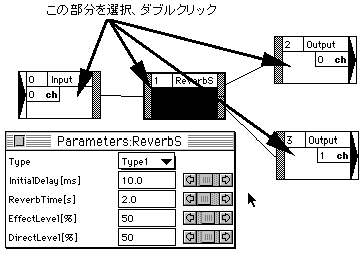
- By changing the value in this parameter edit window, you can change the detailed parameters of the effect. This work can be done in real time while actually playing a song or SE. However, be aware that frequent slider operations during sequence playback can lead to SCSI problems.
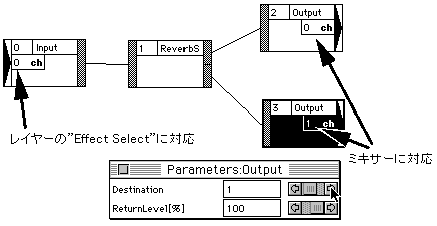
- For effects that give a stereo feel like reverb, prepare two output modules. Then, by assigning different exits, you can shake each one left and right to give it a stereo feel.
The “ch” in the output module corresponds to the channel in the mixer window of the tone editor.
In addition, the input channel “ch” corresponds to “Effect Select” of each layer of the tone editor. Figure 2-29 I / O module editing
- 8) Save the file
- At this stage, the algorithm of the effect you created is only in the target memory, not saved as a file. If you want to save the effect algorithm after it is completed or while you are working on it, select “Save” from the File menu to save it.
When you save, you will have four files with the extensions ".YLI", ".EXL", ".LRI", and ".EXB".- If you want to reopen the previously saved file, open the file with the “.YLI” extension.
- The files that are actually included in the map or passed to the main programmer are files with a ".EXB" extension.
- 9) Modulation effects
- Modulation effects such as chorus and auto pan cannot be linked unless the modulator input buffer number (DSP input buffer number) is specified.
Click the "M" part to open the input buffer setting dialog for the modulator. Figure 2-30 Modulation effects
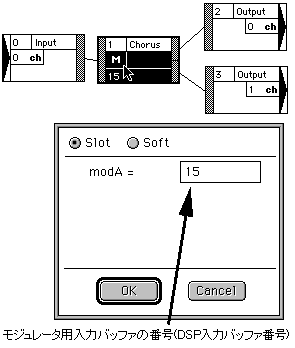
- Be sure to select the "Slot" side for the "Slot" and "Soft" buttons.
- Incorporate the modulation voices such as "VoiceForAutoPan" and "VoiceForModulations" in the DSP tool folder into the tone bank to be used.
Make sure that the DSP input buffer number (Effect Select) of these Voices and the input buffer number for the modulator are the same. (15 are selected for these voices in the initial state)- When using these effects, the Modulation Voice must be in the sounding state. Please put the data to make this Voice sound in the sequence data (Since Direct Level is 0, this Voice will not be pronounced as a sound).
Adjust the modulation speed with this Voice pitch.
